Technology·4 March 2026·6 min read
Near-Edge vs Flat-Head Printing: Why Your Ribbon Cannot Be Generic
P
Written by
Priya Mehta, Engineering Lead

Walk a packaging hall and you will see two very different printer architectures. The flat-head printers — used in most desktop and industrial label printers — press the ribbon and substrate against a flat printhead with the platen roller. The near-edge printers, common in TTO coders for flexible packaging, drag the ribbon across a sharp edge of the printhead while the substrate moves beneath at high speed.
These two geometries demand fundamentally different ribbon chemistry. Flat-head ribbons can use a slow-release ink because the printhead and substrate stay in contact for several milliseconds. Near-edge ribbons must release ink in microseconds — the substrate is moving at up to 1000 mm/s and the contact zone is a knife edge.
Near-edge ribbons therefore use lower-melt-point waxes and a thinner ink layer. Use a flat-head ribbon in a near-edge coder and you get smearing, ribbon wrinkle and incomplete print. Use a near-edge ribbon in a flat-head printer and the print smudges off because the ink never had time to set.
When customers tell us print quality dropped after switching ribbon suppliers, the first thing we ask is which printer architecture they run. The fix is almost always changing the ribbon grade, not the printer settings.
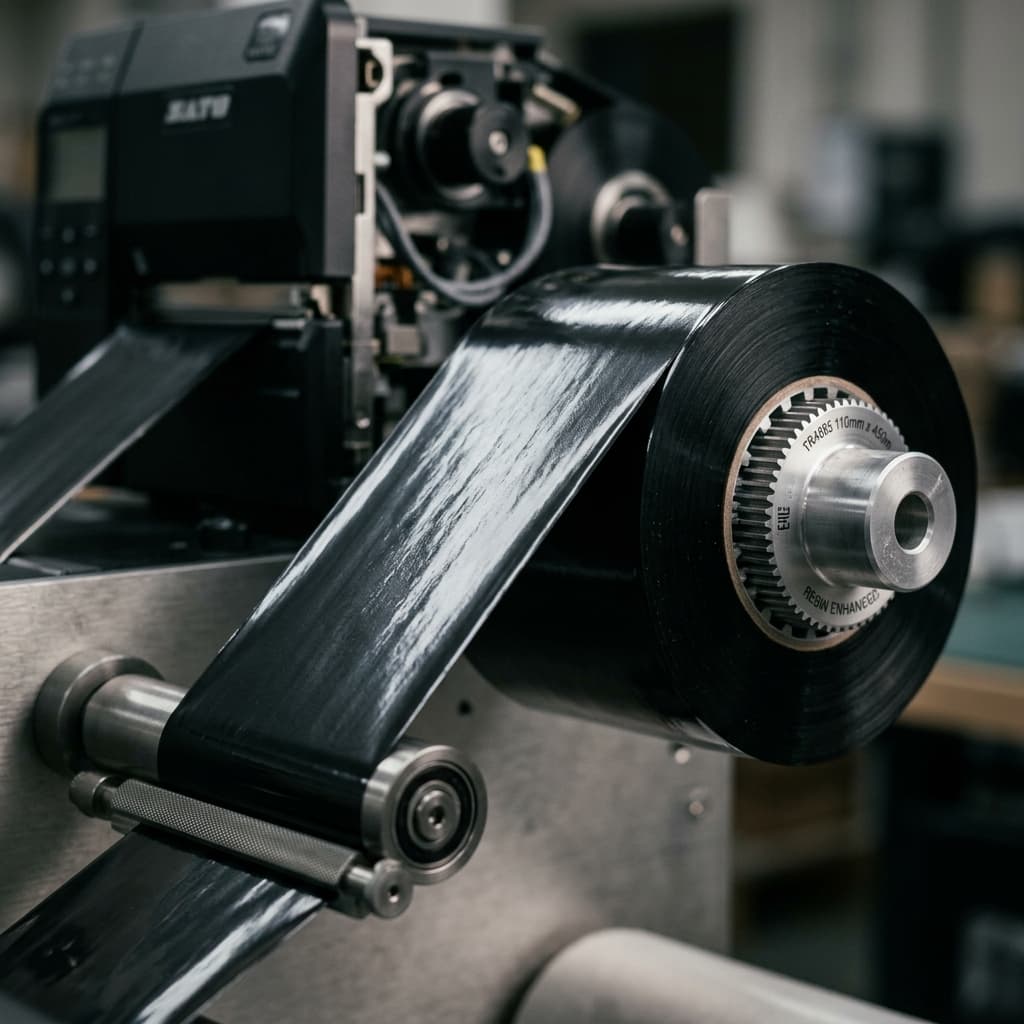
The three thermal transfer ribbon families look identical on a roll. The difference shows up six months later, on a label exposed to oil, sunlight or alcohol. Here is how to pick the right one the first time.

From halogen-free formulations to recycled paper cores, the sustainability conversation has moved from marketing line to procurement spec.

DGFT and CDSCO regulations have evolved fast. Here is a checklist of what your printing and packaging line should already be doing.